How to Find AI Visibility Gaps
Find AI visibility gaps across buyer prompts, mentions, citations, sources, and brand descriptions with a repeatable competitor-audit process.
By Jonathan LiemPublished Updated

Suppose a buyer asks ChatGPT for the best payroll software for a 70-person company operating in three countries. Your closest competitor appears, but your company does not.
Publishing another article may feel like the obvious response, yet the real problem could be elsewhere. Your international payroll page might be blocked from crawling, a comparison site might cover the competitor but omit you, or the AI system may understand your company as a tool for small local teams. Before creating anything, find out which of those problems you actually have.
Start With Ten Questions That Could Affect a Sale
A spreadsheet with 500 synthetic prompts is unnecessary. Ten questions that resemble a buying conversation are a practical starting point, not a statistical standard.
Use four kinds of questions:
| Buyer moment | Example |
|---|---|
| Understanding the problem | How should a B2B team measure visibility in AI answers? |
| Looking for an approach | What is a practical AI visibility plan for a lean marketing team? |
| Comparing providers | Which AI visibility services include managed execution? |
| Reducing risk | Can AI visibility be tied to qualified leads? |
The wording matters. “Tell me about Inflect” only proves that an AI system can discuss Inflect when prompted. “Which AI visibility services run the work for a lean B2B team?” tests whether Inflect enters a real shortlist.
Use questions from sales calls, search queries, customer emails, or support conversations. Give known buying concerns more weight than questions nobody has asked.
Record Four Things, Not One Score
For every answer, capture:
- Mention: Did your brand appear?
- Citation: Was your site or another relevant source linked?
- Description: Was your company described accurately?
- Competitor: Who appeared instead, and in what context?
Also record the platform, date, market, exact prompt, and whether web search was active. AI answers change with wording, conversation context, model, and time.
A simple worksheet is enough:
| Prompt | Your brand | Competitor | Citation | Description accurate? | Notes |
|---|---|---|---|---|---|
| Best managed AI visibility service for a lean B2B team | No | Brand A | Comparison guide | — | Competitor described as full service |
| How to track ChatGPT citations by page | Yes | Brand B | Your guide | Yes | You appear as a software tool |
Keep platforms separate at the start. A strong result in Perplexity does not cancel out an absence in ChatGPT for the same buying question.
Repeat Before You React
One AI answer is an observation, not a market position.
Run the most important questions more than once, keeping the setup consistent. Three separate runs can reveal obvious instability in a directional audit, but they do not create statistical certainty.
Look for gaps that recur:
- across several questions about the same need;
- across repeated runs;
- across more than one relevant AI surface;
- over a useful period of time.
A July 2026 survey of generative engine optimization research describes visibility as variable and only partly observable. That is why a written method matters more than a screenshot of one favorable answer.
Diagnose the Gap
Most useful gaps fall into five buckets.
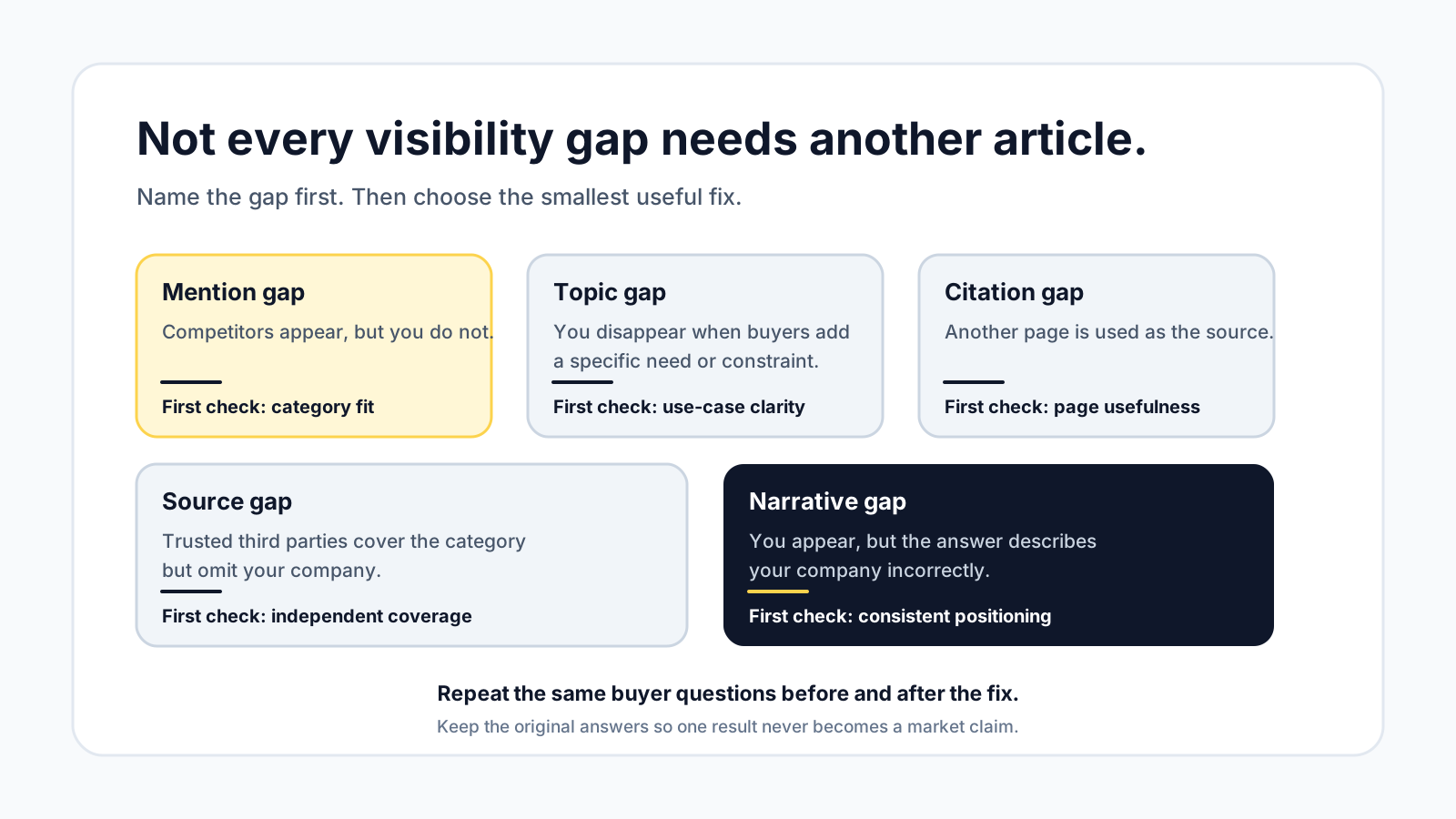
1. Mention gap
A competitor appears and you do not.
This is the visible symptom, not the diagnosis. Check whether the system recognizes your category, use case, audience, and differentiators before deciding to write more.
2. Topic gap
You appear for broad category questions but disappear when the buyer adds an important constraint.
For example, the AI system may understand that you provide payroll software but not that you support multi-country teams. The fix could be a clearer solution page, stronger internal links, or outside evidence connecting your company to that use case.
3. Citation gap
A competitor’s relevant page is cited while yours is not.
Compare the pages directly:
- Does your page answer the question?
- Can crawlers access it?
- Is the useful answer buried?
- Are key claims supported?
- Is the page current?
A citation means a page was presented as a source. It does not prove that the page caused every recommendation in the answer.
4. Source gap
The same independent sources are repeatedly cited alongside relevant answers, but those sources do not mention you.
This cannot always be fixed on your website. You may need accurate profiles, customer reviews, analyst coverage, partnerships, or inclusion in a genuinely relevant comparison.
This is evidence research, not a link-building quota. Find the few sources repeatedly cited for buyer questions in your category.
5. Narrative gap
Your brand appears, but it is described incorrectly or weakly.
This is often more damaging than absence. A buyer may see you as “another dashboard” when the actual offer includes managed execution.
Compare the wording across your homepage, service pages, profiles, review sites, and recent coverage. If the market receives five different descriptions, an AI system will not invent the correct one for you.
Use This Decision Table
| What you observe | Check first | Likely next move |
|---|---|---|
| Page is not crawled | Robots, status code, rendering, canonical | Fix access |
| Page is crawled but never cited | Relevance, clarity, evidence, freshness | Improve the existing page |
| Competitor cited by outside sources | Source pattern and missing brand evidence | Earn or correct third-party coverage |
| Brand appears with the wrong description | Positioning consistency | Clarify core pages and profiles |
| Brand appears only occasionally | Prompt fit and repeated observations | Gather more evidence before acting |
| Traffic arrives but does not convert | Intent, landing page, offer | Fix the buyer journey |
The order matters. Rewriting a page will not solve a crawler block. Adding schema will not fix confused positioning. Publishing a new article will not replace missing independent proof.
A Worked Example
Imagine a fictional company called Northstar Payroll.
Across ten buyer questions, Northstar appears for “payroll software for small companies” but disappears whenever the question includes “multiple countries.” Competitor pages and an industry comparison are cited repeatedly. Northstar’s international payroll page exists, but its opening focuses on “simplifying operations” and never states which countries or employment models it supports.
The useful conclusion is not “Northstar has a 40% AI visibility score.”
It is:
Northstar is understood as general payroll software but is not consistently connected to multi-country payroll. The existing page lacks the concrete eligibility and coverage facts used in buyer comparisons, and the influential industry comparison does not include the company.
That diagnosis creates two sensible actions:
- Rewrite the existing page around the countries, company sizes, integrations, and limitations buyers compare.
- Give the industry publisher accurate information and ask whether Northstar belongs in the relevant comparison.
Now the team has something it can ship and measure.
Choose One Gap Worth Closing
Score each repeated gap on four questions:
- Does this question influence a real buying decision?
- Does your product genuinely fit the answer?
- Is there enough evidence to explain the gap?
- Can you ship a specific improvement?
Prioritize the gap with the strongest commercial value and clearest intervention. The easiest keyword or most embarrassing screenshot is rarely the right starting point.
After making the change, rerun the same questions and keep the original observations. The change log should show:
- what the answer looked like before;
- what you changed;
- when the change shipped;
- what happened afterward;
- what remains uncertain.
That is much more useful than a dashboard that moves without telling you why.
If you need the underlying measurement setup, use this practical LLM visibility guide to separate crawler access, citations, human visits, and conversions.
Frequently Asked Questions
How many prompts should an AI visibility audit include?
As a working heuristic, start with ten questions for a quick first pass and expand to 15 to 30 for a fuller audit. The right count depends on the decisions, markets, and products you need to represent; commercial relevance matters more than a large synthetic list.
How often should I repeat each prompt?
For a directional audit, three separate runs can reveal obvious variability. Higher-confidence conclusions require more runs and observations across time.
Is a competitor citation proof that the cited page caused the recommendation?
No. The page may support one claim while the brand recommendation comes from other retrieved content, model knowledge, or conversation context.
Should I track every AI platform in one score?
No. Report platforms and models separately before creating any blended view because different surfaces can retrieve different brands and sources for the same question.
What is the difference between a source gap and a citation gap?
A source gap concerns an external page or domain repeatedly cited for relevant questions that discusses competitors but not you. A citation gap concerns your relevant page not being selected where another page is.
What should I fix first?
Fix high-value, repeatable gaps with clear product fit and a specific intervention. Access problems generally come before content rewrites.
Find the Gaps on Your Own Site
Inflect’s free AI visibility audit gives you a starting read on how AI systems understand your site. If the opportunity is real, Inflect’s managed AI visibility service can run the research, page changes, publishing, and measurement work with your approval.