How to Measure AI Visibility ROI Honestly
Measure AI visibility ROI using direct, assisted, self-reported, and modeled evidence without turning citations or branded search into fake revenue.
By Jonathan LiemPublished Updated

Once a company starts appearing more often in AI answers, someone will eventually ask the question that matters commercially:
We are showing up more often in ChatGPT. Did it make us any money?
Two answers are tempting and equally unhelpful: multiplying every citation by an invented conversion rate, or dismissing the whole problem because “attribution is impossible.” A useful report takes the middle path by separating what you observed from what you inferred.
AI Visibility ROI Measurement Starts With a Business Result
For a B2B company, the result is rarely “more AI mentions.” It is usually:
- a qualified visitor;
- a demo or planning call;
- an opportunity;
- won revenue;
- gross profit from that revenue.
For ecommerce, the path may be shorter: an identifiable AI referral leads to a purchase with known gross profit.
Choose the outcome before building the report. Otherwise, the dashboard will gravitate toward whatever number moves fastest.
Keep Four Evidence Buckets
Do not combine every signal into one revenue total.
| Evidence bucket | Example | Confidence |
|---|---|---|
| Direct | A ChatGPT referral lands on a page and converts | Highest |
| Assisted | An AI visit appears before a later conversion | Medium |
| Self-reported | A buyer says they found you in Perplexity | Medium |
| Modeled | Visibility increased and you estimate influence using stated assumptions | Lowest |
These buckets can all be useful. They should not all be presented as equally certain.
Rate confidence from the evidence trail
Do not turn confidence into another opaque score. Review the claim against a short checklist:
| Check | Question |
|---|---|
| Identity | Can you identify the page, visitor, lead, or order involved? |
| Sequence | Is the AI touch stored in the correct order with the other touches? |
| Outcome | Is the touch connected to a qualified action, opportunity, or purchase? |
| Alternative explanations | Were there campaigns, launches, or other changes in the same window? |
| Repeatability | Does the pattern appear more than once, or is this one observation? |
A direct referral tied to a purchase may satisfy most of the checklist. A citation increase followed by more branded search may satisfy only part of it. Keep both observations, but describe the second as directional rather than attributable revenue.
Confidence should attach to a specific claim. “This visit came from ChatGPT” and “this page change caused the deal” are different claims and require different evidence.
Direct AI-sourced revenue
This is the cleanest case. The analytics session has an identifiable AI referrer, the visitor converts, and the lead or order is connected to revenue.
Track:
- referring AI surface;
- landing page;
- campaign or content change where known;
- conversion;
- revenue and gross profit;
- date.
Direct attribution still has limits. A buyer may have encountered the company elsewhere before clicking. “Direct AI-sourced” means the observable converting path began with that referral, not that AI deserves 100% of the buyer’s awareness.
AI-assisted revenue
The AI visit occurs earlier in the journey, while another channel receives the final conversion credit.
For example:
- A buyer clicks a cited article from Perplexity.
- They return through branded search two weeks later.
- They book a call.
- The opportunity closes.
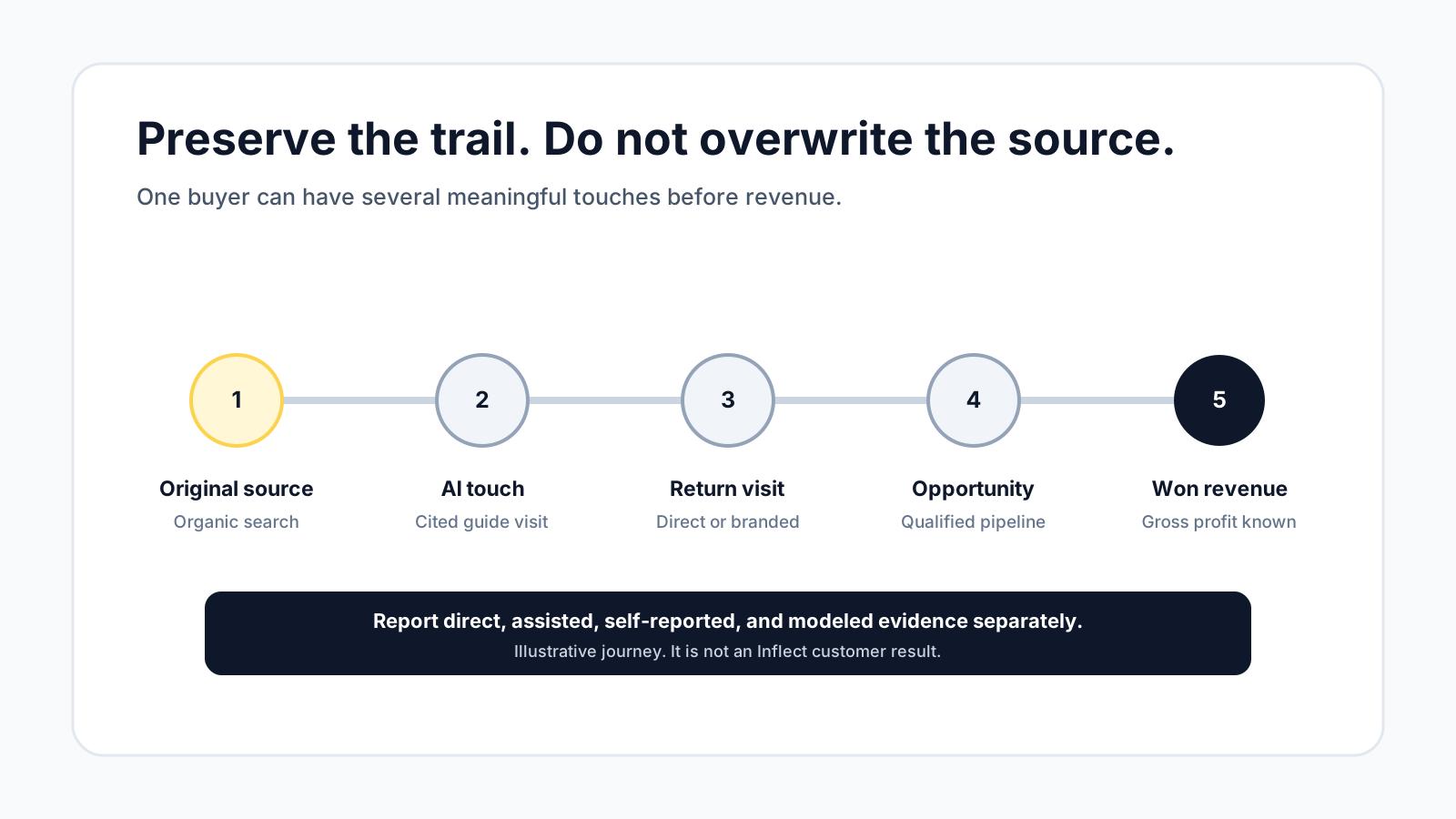
The AI touch belongs in the trail. It should not overwrite the original source or automatically claim all the revenue.
Buyer-reported AI influence
Some buyers never click a trackable AI link. They remember the brand name, open another tab, and visit directly.
Add a short “How did you hear about us?” field with an AI assistant option and a free-text follow-up. Train sales to ask one natural question:
What were you researching when you first came across us?
Keep the buyer’s exact answer. “ChatGPT” is useful. “I asked ChatGPT for an AI visibility service that would run the work for us” is much more useful.
Modeled AI influence
Models are helpful when direct evidence is incomplete, but they are estimates.
If you model revenue, show:
- the formula;
- the time window;
- the assumed conversion rate;
- the assumed influence weight;
- the reason for each assumption;
- a low, expected, and high case.
Never quietly add modeled revenue to directly observed revenue.
Preserve the Entire Acquisition Trail
One lead can have several meaningful touches. Store them instead of fighting over one source field.
A practical CRM record includes:
| Field | Example |
|---|---|
| Original source | Organic search |
| Touch history | ChatGPT referral → direct return → webinar |
| Latest source | Direct |
| Self-reported source | “Found your guide in ChatGPT” |
| First AI touch | ChatGPT, July 7 |
| AI landing page | /blog/how-to-find-ai-visibility-gaps |
| Opportunity and revenue | Connected CRM records |
Do not overwrite original_source when an AI touch occurs. Append an event to the touch history and update latest_source separately.
That one decision prevents a large attribution problem later.
Build the Minimum Tracking Chain
You do not need a perfect warehouse before you begin.
1. Analytics
Start with GA4's built-in AI Assistants channel. Add a custom channel or report only for sources or groupings the default definition misses, and keep the raw source and medium values so you can audit the grouping.
Google Analytics documents its default channels and custom channel groups, but not every AI interaction arrives with a distinct referrer. Google AI Overviews and AI Mode remain under Organic Search, and some other visits may still be grouped as Referral or Direct.
2. CRM
Send the landing page, referral source, campaign information, and anonymous identifier into the lead record where consent and your privacy policy allow it.
Preserve:
- original source;
- latest source;
- ordered touch history;
- self-reported discovery;
- opportunity and revenue connection.
3. Sales
Ask how the buyer discovered you and what they were researching. A short note from a real conversation can explain a journey that analytics cannot see.
4. Change log
Record what you shipped:
- page created or changed;
- publish date;
- target buyer question;
- baseline visibility;
- cost;
- later visibility, traffic, lead, and pipeline observations.
Without a change log, a chart can move while the team has no idea what caused it.
Calculate ROI at the Confidence Level You Have
Use gross profit when possible:
ROI = (Attributable gross profit - AI visibility cost) / AI visibility cost
Here is an illustrative example, not an Inflect result:
| Evidence | Gross profit connected | Treatment |
|---|---|---|
| Direct AI referrals | $12,000 | Include in direct case |
| AI-assisted won deals | $18,000 | Report separately or apply a documented weight |
| Buyer-reported AI discovery tied to won deals | $8,000 | Report separately |
| Estimated no-click influence | $15,000 | Modeled only |
| Program cost | $10,000 | Include in every scenario |
The direct case is:
($12,000 - $10,000) / $10,000 = 20%
An assisted case might include part of the assisted and self-reported value, but the weighting must be visible. The modeled $15,000 should remain in a scenario, not be presented as observed revenue.
A trustworthy report can say:
We observed $12,000 in gross profit from direct AI-referred journeys. Another $26,000 in gross profit came from won deals that involved an AI touch or buyer-reported AI discovery. The direct case produced a 20% ROI against $10,000 in cost; the assisted evidence remains separate because influence is uncertain.
That sentence is less exciting than “AI generated $53,000.” It is also something a finance team can examine. This evidence framework makes the uncertainty visible instead of hiding it inside one number.
Report the Funnel Before Revenue Arrives
B2B sales cycles can outlast the reporting period. Before deals close, report the chain without pretending the early stages are revenue:
| Stage | What to show |
|---|---|
| Work shipped | Pages, technical fixes, third-party updates |
| Visibility | Repeated mentions, citations, answer accuracy |
| Engagement | AI referrals, landing pages, qualified behavior |
| Demand | Form fills, calls, self-reported discovery |
| Pipeline | Qualified opportunities and stage |
| Revenue | Won revenue and gross profit |
| Confidence | Direct, assisted, self-reported, or modeled |
If the report stops at citations, call it a visibility report rather than stretching it into a revenue claim.
For the operational setup behind these numbers, read how to measure LLM visibility.
Avoid These Attribution Traps
Giving every citation a dollar value
A citation can influence awareness without producing a click or sale. Treat it as a leading indicator until stronger evidence connects it to demand.
Calling all direct traffic “hidden AI”
Some AI-influenced visits will lose their referrer. Direct traffic also includes bookmarks, untagged links, privacy restrictions, and other unknown sources. Unknown is not the same as AI.
Overwriting the original source
Preserve the first touch and append later AI interactions. One mutable source field destroys the journey you are trying to measure.
Claiming causation from timing
Revenue increasing after a page change does not prove the page caused the increase. Compare the timeline, supporting evidence, and plausible alternatives.
Ignoring cost
Count research, writing, engineering, tools, distribution, and service fees. Revenue without cost is not ROI.
Frequently Asked Questions
Can AI visibility ROI be measured exactly?
Only the directly observable portion can be measured with high confidence. Assisted and no-click influence require self-reported, sales-confirmed, or modeled evidence.
Should citations be assigned a dollar value?
A citation is a leading indicator, so it should not receive a financial value by default. If you assign one through a documented model, label the result as modeled and show the assumptions.
What is the best AI visibility conversion metric?
For B2B, qualified opportunities and connected gross profit are stronger than raw form fills. For ecommerce, purchases and gross profit from attributable sessions are stronger than visits.
Should an AI referral overwrite the lead’s original source?
No. Preserve the original source, append the AI touch, and store the latest source and self-reported discovery separately.
How should I treat Google AI Overviews in GA4?
GA4's current default channel group includes an AI Assistants channel for recognized sources such as ChatGPT, Gemini, Deepseek, Copilot, and Grok. Google AI Overviews and AI Mode remain under Organic Search. Use a custom channel group when you need to add or regroup sources the default definition misses, and use Search Console's generative AI report where available for additional visibility context.
What should I report before any AI-influenced revenue closes?
Report the baseline, shipped work, visibility movement, referrals, qualified leads, open pipeline, costs, and evidence limitations. Do not manufacture an ROI figure.
Measure the Work Without Inventing the Return
Inflect’s managed AI visibility service helps B2B teams improve AI visibility and connect shipped work to traffic, lead, and pipeline evidence. Start with the free AI visibility audit to see whether there is a meaningful gap worth addressing.