How to Set Up Page-Level AI Citation Tracking
A practical guide to tracking verified bot requests, answer citations, AI referrals, page changes, event fields, and acceptance tests.
By Jonathan LiemPublished Updated

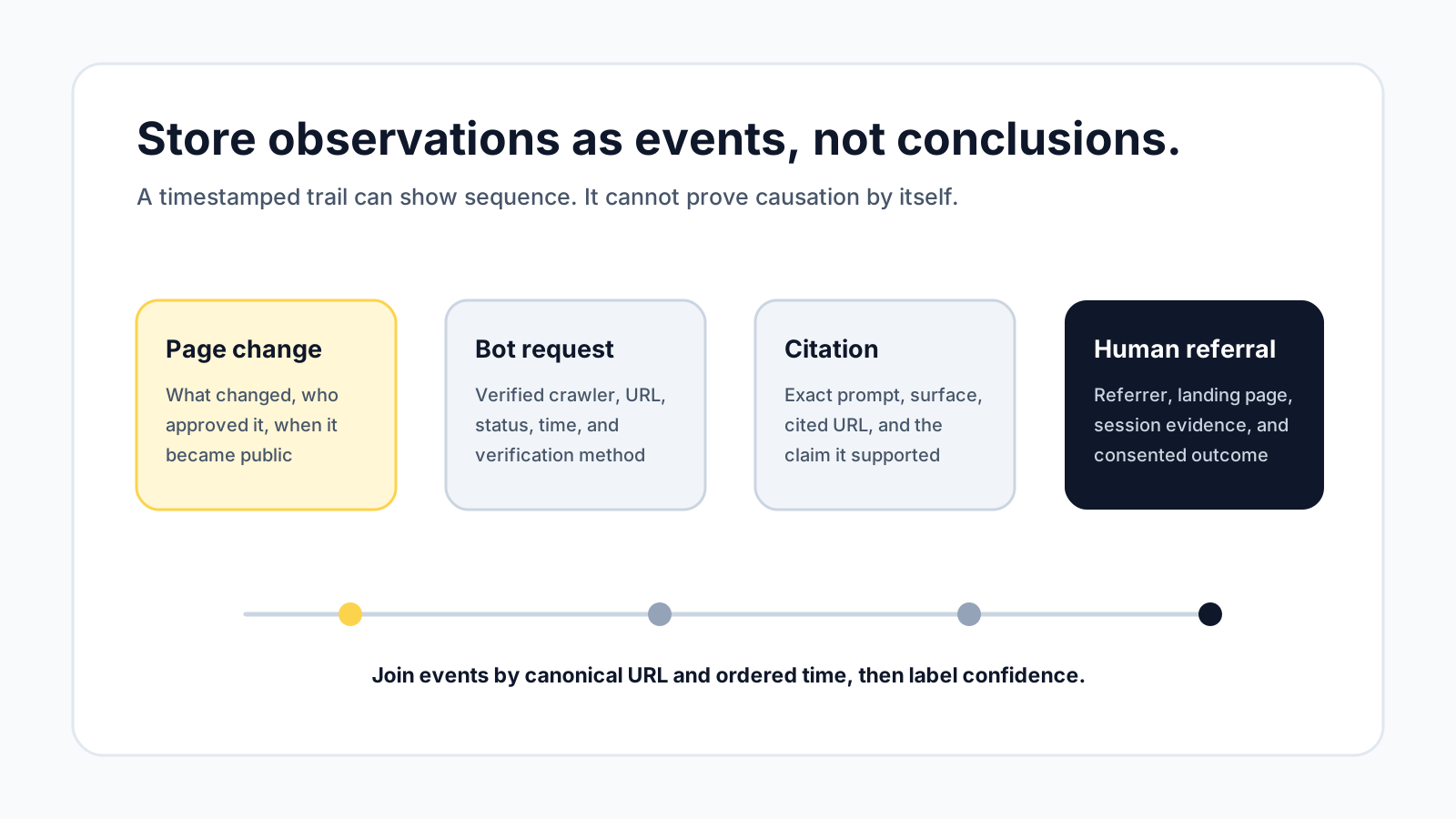
When marketing asks engineering for “better AI attribution,” the phrase can refer to four different events: a bot requesting a page, the page appearing as a citation, a person visiting from an AI answer, or a known page change going live. If the team does not separate those events at the start, the dashboard will eventually imply more certainty than the data supports.
This guide is for marketing operations, analytics, and engineering teams turning that vague request into a shared implementation specification. It covers the records to collect, the fields each record needs, who owns each part, and the tests that keep a useful timeline from becoming a causal claim.
For the measurement model around these records, first read how to measure LLM visibility. This guide handles the implementation details.
Start With What You Can Observe
Before choosing tools, agree on the evidence each tool can produce.
| Record | What it establishes | What it does not establish |
|---|---|---|
| Verified bot request | A verified automated system requested a URL | The page was indexed, retrieved for an answer, cited, or read by a person |
| Citation observation | A URL appeared as a source in one captured answer | The citation produced a click, sale, or lasting visibility |
| AI referral visit | A person arrived with an identifiable AI referrer or controlled link | The AI interaction was the person's first or only influence |
| Page change | A specific version went live at a known time | The change caused a later citation or visit |
This separation is not academic. Microsoft's bot activity documentation says requests do not indicate that content was retrieved, grounded, cited, or surfaced in an AI answer. Its citation documentation also notes that citation counts are references, not answer rank or prominence.
The timeline becomes more useful as these records accumulate. It still describes observed sequence and association, not causation.
Assign an Owner to Each Record
Page-level tracking fails when every team assumes another team owns the missing field, so assign responsibility before implementation.
| Owner | Responsibility |
|---|---|
| Marketing or content | Define the buyer questions, maintain the tracked-page list, capture citation evidence, and describe page changes |
| Engineering or infrastructure | Export server or edge requests, verify bot identity, normalize URLs, and maintain the event pipeline |
| Analytics or growth | Separate human visits from bot requests, preserve referrers, and connect visits to approved conversion events |
| Privacy or security | Approve data collection, access controls, retention, and treatment of IP addresses or pseudonymous identifiers |
| Program owner | Review evidence quality, document limitations, and decide what should be investigated next |
Marketing owns the measurement question, while engineering owns the reliability of the collection system. Neither team should have to infer the other's intent.
Build a Canonical Page Inventory
Start with a short list of commercially important pages. Each page record should contain:
- a stable, team-defined page key;
- the canonical URL;
- page type and business purpose;
- page owner;
- publish date;
- time of the most recent material change;
- production environment;
- current status, such as active, redirected, or retired.
Normalize ordinary variations such as tracking parameters, fragments, trailing slashes, and redirects to the canonical URL, but keep the originally observed URL as evidence of what the system or visitor requested.
Begin with enough pages to test the data flow and expose ambiguous cases, not the whole site. Expand only after the team can inspect the raw evidence behind each record.
Record Server or Edge Requests
Ask engineering or the CDN owner for request-level records, not a screenshot of total bot traffic.
Minimum request fields
| Field | Why it matters |
|---|---|
observed_at | Orders events in a common time zone, preferably UTC |
request_id | Supports deduplication and debugging |
method | Separates page requests from other request types |
host and path | Identifies the requested resource |
query_string_present | Flags variants without retaining sensitive query values by default |
status_code | Shows whether the request succeeded, redirected, or failed |
response_bytes | Helps detect empty or unexpected responses |
user_agent_raw | Preserves the claim made by the requester |
source_ip | Supports provider verification; restrict access and retention |
bot_family_claimed | Stores the family suggested by the user agent |
verification_status | Records verified, unverified, or failed |
verification_method | Records the provider rule, published IP range, or DNS method used |
verification_rule_version | Makes later audits possible when providers change their rules |
cache_status | Helps explain whether the origin served the request |
release_or_build | Connects the response to the version serving at that time |
Exclude cookies, authorization headers, form values, and full query strings from the analysis table. IP addresses may be needed temporarily to verify a provider, but they require restricted access, an approved retention period, and review under your privacy policy.
Verify the requester, not just the user agent
A user-agent string is a claim, not an identity. Anyone can send a request that says it is Googlebot, OAI-SearchBot, or another named crawler.
Use one of these verification methods:
- A server or CDN integration that identifies verified bots and documents its method.
- The operator's current published IP ranges.
- The operator's documented forward-and-reverse DNS process, where available.
Google documents both published IP-range matching and forward-and-reverse DNS verification for its crawlers. OpenAI publishes separate IP lists for its crawler families.
Keep provider roles separate. OpenAI currently documents:
OAI-SearchBotfor search;GPTBotfor potential model-training use;ChatGPT-Userfor certain user-triggered actions.
Keep these separate rather than merging them into one “OpenAI crawl” metric because their purposes and robots behavior differ. Store the documentation URL and review date with the verification rule because names, IP ranges, and behavior can change.
If the user agent matches but verification fails or cannot run, keep the event as unverified. A matching name alone is not enough to promote it to a verified bot request.
Capture Citation Observations
Because a mention is not the same as a citation, record the event only when the answer surface presents a link or source reference that resolves to the page.
For each observation, capture:
- observation time and time zone;
- platform and answer surface;
- exact prompt or buyer question;
- market, language, and relevant account state;
- whether web search was active, if shown;
- model name only when the platform displays it;
- the URL exactly as cited;
- the normalized canonical URL;
- the claim or answer section the citation supported;
- evidence such as a screenshot, exported response, or saved capture;
- collector and collection method;
- whether the brand was mentioned separately from the citation.
Use a new conversation when you need a clean observation. If the test includes prior conversation context, record that context because it can affect the answer.
OpenAI's search guidance confirms that search responses may include inline citations and a Sources panel, but it does not promise that every response will expose the same evidence. Preserve what the interface showed and mark unavailable fields as unknown.
Repeated observations make variability visible. They do not turn the result into a guaranteed position or a causal experiment.
Keep Human Visits Separate
Bot requests belong in server or edge logs, while human visits belong in analytics; combining the two creates a misleading traffic story.
For an identifiable AI-origin visit, keep:
- observation time;
- landing URL and canonical URL;
- raw referring host when available;
- the channel rule that classified the visit;
- a pseudonymous session or event identifier;
- consent state where required;
- approved engagement or conversion events;
- controlled campaign parameters only when your organization created the link.
Some AI-influenced visits will not carry a distinct referrer. Record them as unknown unless you have another explicit source, such as a buyer's form response or a sales note. Direct traffic should remain direct rather than being relabeled as hidden AI traffic.
A controlled redirect can measure a link you own and distribute, but it cannot identify every third-party citation or recover a referrer that was never sent.
Maintain a Page Change Log
A change log should describe what went live without claiming that it worked.
Record:
- canonical URL;
- publish time;
- version label, commit, or release reference;
- plain-language change summary;
- reason for the change;
- expected observation;
- owner and approver;
- known overlapping launches, campaigns, or technical incidents.
Write the expectation as a hypothesis: “We expect the clearer definition to be cited more often for this buyer question.” The statement “This change will increase citations” writes the outcome into the hypothesis.
The change log lets the team compare events before and after publication. It does not eliminate seasonality, competitor changes, platform updates, prompt variability, or other confounders.
Use One Event Envelope
Store each observation as an immutable event, using an event envelope to keep shared fields consistent while allowing each event type to carry its own details.
{
  "schema_version": "1.0",
  "event_id": "evt_example_001",
  "event_type": "bot_request",
  "observed_at": "2026-07-28T19:42:11Z",
  "canonical_url": "https://joininflect.com/blog/example-guide",
  "observed_url": "https://joininflect.com/blog/example-guide?ref=sample",
  "collection_method": "edge_log",
  "evidence_reference": "request-log:req_example_001",
  "verification": {
    "status": "verified",
    "method": "published_ip_range",
    "rule_source": "provider_documentation",
    "rule_reviewed_at": "2026-07-28"
  },
  "details": {
    "request_id": "req_example_001",
    "method": "GET",
    "status_code": 200,
    "bot_family": "example_search_bot",
    "cache_status": "HIT"
  }
}
This record is illustrative. It is not production data or evidence of an Inflect result.
Use the same envelope for the other event types:
event_type | Required details |
|---|---|
bot_request | Request ID, method, status, raw user agent, claimed bot, verification result, cache status |
citation_observation | Platform, prompt, cited URL, supported claim, capture reference, collection context |
referral_visit | Referring host or controlled source, landing page, pseudonymous event ID, consent state |
page_change | Version reference, publish time, change summary, hypothesis, owner, confounder notes |
Never overwrite an earlier event when a later event arrives. Append the new record. If an event was classified incorrectly, add a correction with an audit trail.
Label Confidence in the Observation
Confidence should describe the evidence you captured, not the business impact you hope to prove.
Use plain labels:
- Verified: Direct evidence exists and the relevant identity check passed.
- Observed: The event was captured directly, but provider identity was not part of the claim. A saved citation is a common example.
- Inferred: The classification depends on timing, a partial referrer, or another stated assumption.
- Unknown: The required evidence is missing.
An unexplained 0-to-100 attribution score would hide the distinction between these labels. A verified bot request and an observed citation are still two separate facts. Adding their confidence levels together does not prove a causal link.
Give Engineering Acceptance Tests
A handoff is incomplete without testable requirements.
Ask engineering and analytics to demonstrate that:
- A test request that reaches the collection path creates one event with a UTC timestamp and canonical URL.
- Duplicate delivery does not create duplicate events.
- Tracking parameters and redirects preserve the observed URL while resolving to the correct canonical URL.
- A matching user agent with an unverified IP remains
unverified. - A verified provider request records the verification method and rule version.
- Bot requests do not appear as human sessions or conversions.
- Missing referrers remain unknown rather than being assigned to AI.
- Page changes append a new event without modifying prior traffic or citation records.
- Evidence references can be opened by authorized reviewers.
- Retention and deletion behavior matches the approved privacy policy.
Test with synthetic events before waiting for a real crawler or citation. Label every synthetic record so it cannot enter a production report as real evidence.
Review the Data as a Timeline
The first useful report is a page-level timeline rather than a single score:
| Time | Event | Evidence | Interpretation |
|---|---|---|---|
| Day 1 | Page change published | Release record | The new version is live |
| Day 3 | Verified bot request | Edge log and provider rule | The provider requested the page |
| Day 8 | Citation observed | Saved answer capture | The page appeared as a source in one answer |
| Day 8 | No identifiable visit | Analytics | No matching referral was observed |
The example is illustrative and the intervals are not a promised timeline.
A responsible conclusion would be: “The new page version was live before a verified request and a later citation observation. We did not observe a matching referral visit.” It would not be: “The page change caused the citation.”
Marketer-to-Engineering Handoff Template
Copy this into the implementation ticket:
Business question
Which priority pages are requested by verified bots, observed as citations, and visited from identifiable AI sources?
Tracked pages
List the canonical URLs, owners, and business purpose.
Required event types
bot_request, citation_observation, referral_visit, and page_change.
Identity rules
User agent alone is insufficient. Store verification status, method, rule source, and review date.
Evidence rules
Every citation observation needs a cited URL and saved capture. Every inferred referral needs its assumption. Unknown values remain unknown.
Privacy rules
Exclude secrets and form data. Restrict IP access. Define retention and deletion before launch.
Reporting rule
Show the four event types separately and describe sequence or co-movement as association, not causation.
Acceptance tests
Attach the ten tests above and name the owner who will sign off on each one.
Frequently Asked Questions
Does a verified bot request mean the page was cited?
A verified request only means the provider requested the resource; retrieval, grounding, citation, display, and a human visit remain separate events.
Can citation capture be automated?
Some collection can be automated, depending on the surface and its terms. Keep the original evidence, record the collection method, and manually review samples. Automation does not remove answer variability.
Does linking a citation to a page version prove the version caused it?
Linking a citation to a page version establishes sequence and narrows the investigation, but causal claims require a design that addresses alternative explanations.
What if an AI visit has no referrer?
Record the source as unknown. Buyer-reported discovery or a later sales note can be stored as a separate event, but it should not rewrite the original analytics record.
Do I need special schema markup before tracking citations?
Tracking depends on observable requests, citations, visits, and page changes rather than special markup. Google says there is no special schema required for AI Overviews or AI Mode, though any structured data you use should match the visible page.
How quickly should a citation appear after a page change?
There is no universal interval. Crawl frequency, indexing, query demand, answer variability, and platform behavior differ. Set an observation cadence that matches the business question and report the absence of evidence honestly.
Turn the Handoff Into Managed Work
If your team wants the visibility readout without operating another measurement project, start with Inflect's free AI visibility audit. If the opportunity is real, Inflect's managed service can run the research, page work, publishing, and reporting with your approval.