Generative Engine Optimization vs SEO
A practical GEO vs SEO comparison for deciding whether a page needs better discovery, clearer evidence for AI answers, or both.
By Jonathan LiemPublished Updated

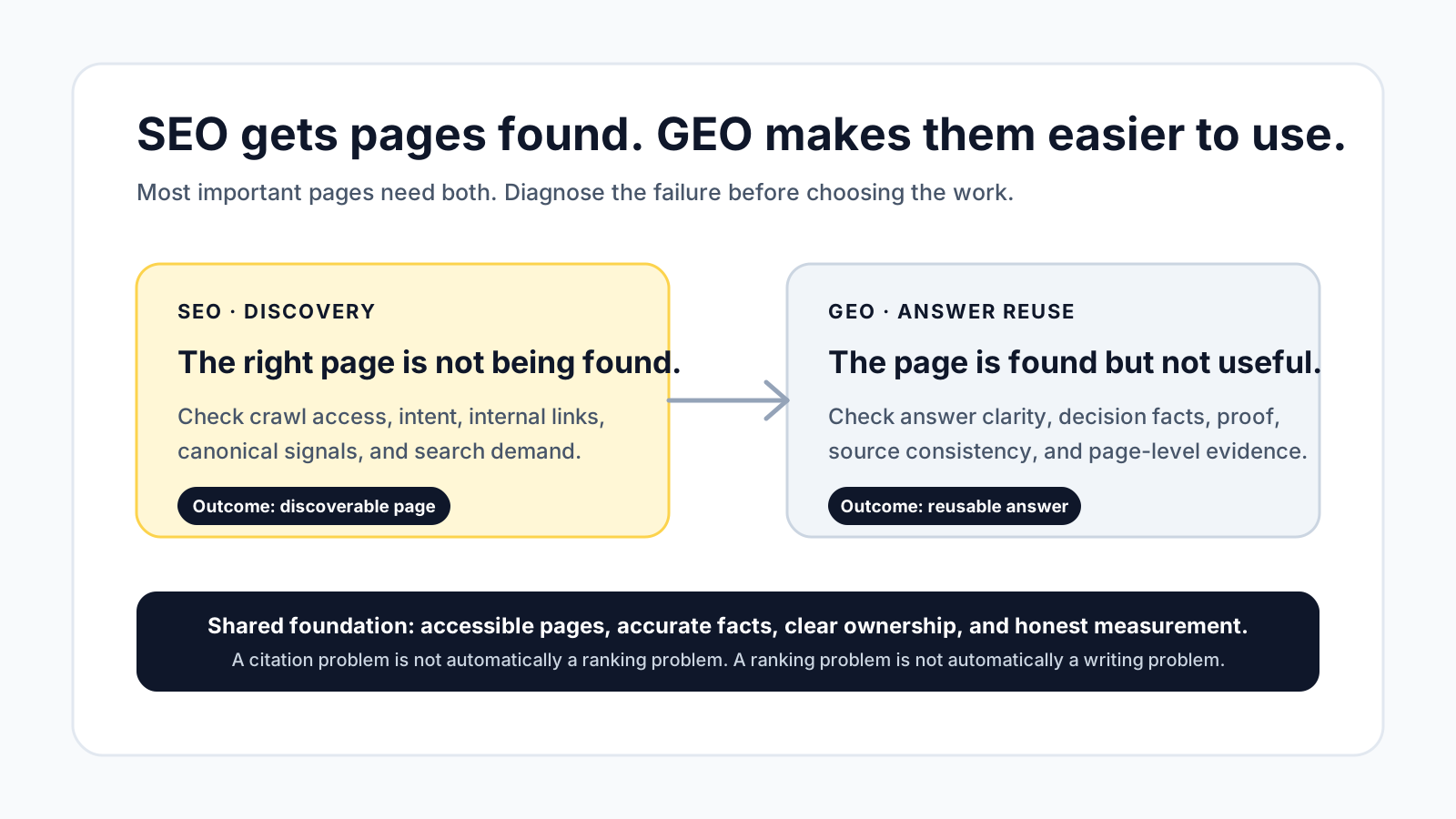
A comparison page can rank on Google, earn impressions, and bring in qualified visits while still disappearing from an AI-generated shortlist. When that happens, the next move is not automatically “more SEO” or “more GEO.” It depends on where the page is failing.
Start by checking whether search and retrieval systems can access the page and connect it to the buyer's question. That is still SEO territory. If the page is already discoverable, look at what it gives the buyer: does it state who the product is for, answer the question directly, and support its claims? That is where GEO work begins.
GEO vs SEO in One Table
| SEO | GEO | |
|---|---|---|
| Primary job | Help the right page get discovered and earn a visit | Help AI systems use the page accurately in an answer |
| Typical unit of work | Page, query, internal link, technical issue | Answer passage, claim, evidence, comparison |
| Common failure | The page is not crawled, indexed, or relevant enough | The page is found but vague, unsupported, or difficult to reuse |
| Useful evidence | Indexing, rankings, impressions, clicks, qualified organic visits | Repeated mentions, cited URLs, accurate descriptions, AI referrals |
| Business question | Can buyers find this page? | Can an AI answer use this page when buyers compare options? |
The two practices overlap. A clear page with good evidence can help both traditional search and AI answers. The difference is the problem you are trying to solve.
What SEO Still Does
SEO remains the foundation. A page cannot become a dependable source if search and retrieval systems struggle to access or understand it.
For a commercially important page, SEO covers work such as:
- returning a successful status code;
- using a stable canonical URL;
- making the important text available in rendered HTML;
- matching a real search need;
- using a clear title and headings;
- connecting the page through useful internal links;
- earning qualified search impressions and visits.
Google's SEO Starter Guide recommends descriptive titles and URLs, logical site organization, and content created for people. Its developer guidance also stresses accessible text, semantic HTML, and crawl checks.
None of that becomes obsolete because buyers also use AI assistants.
What GEO Adds
GEO asks a second question: if an AI system retrieves this page, is the page a useful source for the buyer's question?
The original GEO research paper studied ways content changes could affect visibility in generated answers. Its important practical finding was not a universal ranking formula. Results varied by topic, which is why page changes should be tested rather than treated as guaranteed tactics.
For a B2B page, GEO usually means improving four things:
- Directness: State the answer before the background.
- Decision detail: Include the facts a buyer needs to compare options.
- Evidence: Place a source, product fact, or clearly labelled company analysis beside the claim it supports.
- Consistency: Describe the company, audience, and offer the same way across important pages and credible external profiles.
These are not tricks for machines. They reduce the work a human reader has to do before trusting the page.
Use SEO When Discovery Is Broken
Start with SEO when:
- the page is not indexed;
- the canonical URL is wrong;
- the useful content is hidden from crawlers;
- the page does not match the query you expect it to serve;
- search impressions and qualified visits are weak;
- several pages compete for the same purpose.
Rewriting the opening will not fix a blocked page or confused site structure.
Use GEO When the Page Is Found but Not Used Well
Start with GEO when:
- the page ranks or receives qualified organic traffic but rarely appears in relevant AI answers;
- the brand appears but is described incorrectly;
- a competitor's page is repeatedly cited for a question yours should answer;
- your core claim is buried beneath introductory copy;
- the page makes claims without nearby proof;
- buyers need concrete limits, comparisons, or implementation facts that the page omits.
Do not assume every missing citation is a content problem. Repeat the same buyer questions, check more than one answer, and inspect which sources recur before choosing a fix.
Use Both on New High-Value Pages
For a new service, category, comparison, or implementation page, SEO and GEO should be planned together.
The page still needs a clear purpose, crawlable text, a stable URL, and internal links. It also needs an answer a buyer can use: who the offer is for, what it does, what evidence supports it, and where the limits are.
That combination is more useful than producing one version "for Google" and another "for AI."
A Fast Decision Check
Use this order before approving another rewrite:
| What you observe | Check first | Likely next move |
|---|---|---|
| Page is not indexed or accessible | Status, robots rules, rendering, canonical | SEO fix |
| Page is indexed but attracts the wrong searches | Search intent and page purpose | SEO and positioning |
| Page gets relevant traffic but is not cited | Answer clarity, decision facts, evidence | GEO review |
| Brand is mentioned inaccurately | Positioning across owned and external sources | GEO and brand consistency |
| Page is cited but sends no qualified visits | Citation context, buyer intent, page promise | Conversion and offer review |
| Results vary from one run to another | Prompt wording, platform, date, repeated observations | Gather more evidence |
The goal is not to label every task SEO or GEO perfectly. It is to fix the actual break instead of publishing more content by default.
A Practical Workflow for One Page
- Choose one buyer question that could affect a sale.
- Confirm the page can be accessed and clearly matches that question.
- Record whether your company and URL appear across repeated answers.
- Compare the cited sources with your page.
- Fix the clearest gap: access, answer, evidence, positioning, or offer.
- Record what changed and rerun the same observations.
If you need the editing process, use the separate guide to optimizing content for AI search. If you are still defining the category, read what generative engine optimization means.
Frequently Asked Questions
Is GEO replacing SEO?
No. SEO still helps search and retrieval systems discover and understand pages. GEO adds focused work for pages that should also support accurate AI answers.
Can a page perform well in SEO and still be absent from AI answers?
Yes. A page can rank for a relevant query while omitting the decision facts, evidence, or clear positioning used in a particular AI answer. One missing appearance is not proof of a persistent gap, so repeat the observation before acting.
Does GEO mean writing for machines?
No. Good GEO work makes a page easier for people to use too: answer sooner, name the subject, show the evidence, and explain trade-offs.
Should every page receive GEO work?
No. Prioritize pages that answer buyer questions, explain the product or service, compare options, or reduce purchase risk.
How should a team measure GEO work?
Keep SEO metrics, then separately record repeated AI mentions, cited URLs, answer accuracy, identifiable AI referrals, and any qualified actions. Do not turn those signals into guaranteed revenue.
Find the Actual Gap Before You Rewrite
Inflect helps B2B teams find the buyer questions worth winning, improve the pages AI systems should trust, publish with approval, and report what moved. Start with the free AI visibility audit to see whether the first problem is discovery, evidence, positioning, or measurement.