How to Optimize Content for AI Search
A practical workflow for improving an existing page for AI search without rewriting blindly or treating citations as guaranteed outcomes.
By Jonathan LiemPublished Updated

Suppose your company has a Salesforce integration page that is indexed and already receives search traffic. When a buyer asks an AI assistant which tools support Salesforce, however, a competitor appears and your company does not.
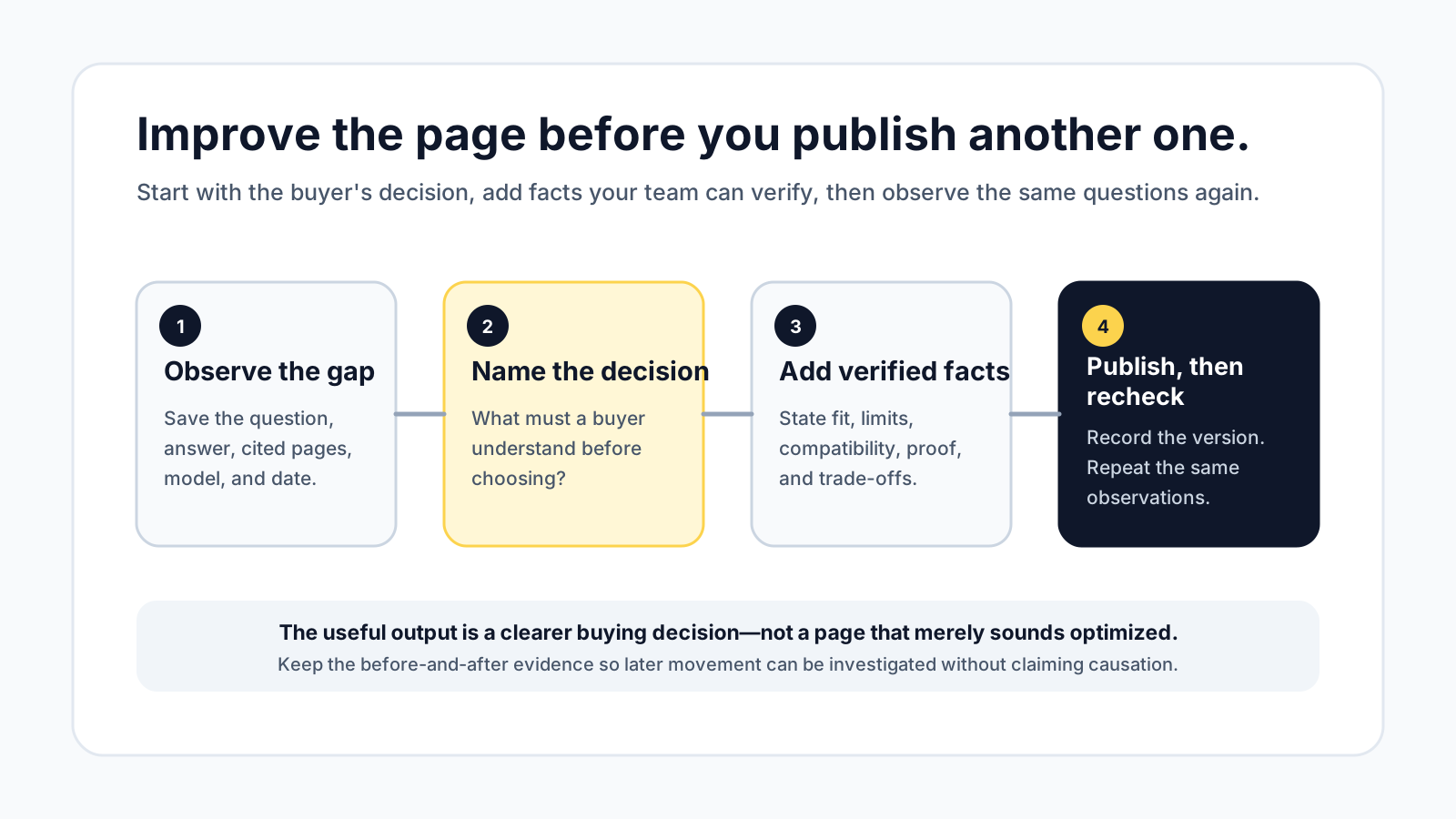
Rewriting the entire page immediately would hide the question you need to answer first: where is the break? The page might be blocked from an important crawler, never explain what the integration does, bury the answer below six paragraphs of setup, or be absent from the independent comparisons an AI system is using. The workflow below helps you identify and fix the most plausible problem without discarding everything that already works.
1. Choose One Buyer Question
Optimize for a question a buyer genuinely asks, not the abstract goal of "AI visibility."
Good questions include a use case, audience, constraint, or comparison:
- Which payroll platforms support contractors in several countries?
- What AI visibility services will run the work for a lean marketing team?
- Does this security product integrate with Okta and Salesforce?
- Which customer-data platforms support EU data residency?
Start with questions from sales calls, customer emails, search queries, or support conversations. A synthetic prompt with no connection to a buying decision should not lead the roadmap.
Write the target question at the top of the editing brief. Every change should help the page answer it more accurately.
2. Record the Page Before Changing It
Take a small baseline so you can tell whether the problem is access, content, outside evidence, or measurement.
Record:
- the live URL and date;
- whether the page returns successfully and uses the expected canonical URL;
- the answer currently given near the top;
- the important product facts and limits on the page;
- whether your company and URL appear across several relevant AI answers;
- which competitors and sources appear instead;
- any identifiable AI referrals or qualified actions.
One answer is an observation, not a trend. Repeat important questions and keep the platform, wording, date, and search setting with the result.
3. Rewrite the First Useful Answer
The opening does not need to contain the entire article. It should let a reader decide whether the page is relevant.
Before
Modern revenue teams need connected systems to create seamless customer experiences. Our powerful integration helps businesses unlock more value from their technology stack.
The paragraph never names the systems, the data being shared, or the limits.
After: fictional example
The Acme Salesforce integration sends qualified lead, opportunity, and account updates into Acme every 15 minutes. It supports Salesforce Enterprise and Unlimited editions. Custom-object syncing requires a separate configuration.
The second version is useful because it answers three buyer questions: what moves, how often it moves, and where the limit is.
Use only facts your product team can verify. Invented precision makes a paragraph less trustworthy, not more authoritative.
4. Add the Facts That Decide the Purchase
Most weak B2B pages describe a category. Strong pages help someone make a decision.
For the target question, list the facts a buyer needs:
| Buyer need | Useful page detail |
|---|---|
| Fit | Company size, role, industry, or use case |
| Compatibility | Platforms, editions, integrations, file types, or environments |
| Scope | What is included and excluded |
| Evidence | Product documentation, customer result, test method, or primary source |
| Risk | Security, privacy, implementation, support, or contract limits |
| Next step | What the buyer can evaluate or ask for |
Put important evidence beside the claim it supports. A security certification should link to the relevant trust or compliance page. A customer result should name the customer and method if permission allows. Company analysis should be labelled as company analysis.
Google's people-first content guidance asks whether a page offers original information or analysis and leaves the reader feeling they learned enough to achieve their goal. That is a useful editorial standard even when the target surface is not Google.
5. Make Each Important Section Understandable
A useful section should make sense to someone who lands on it directly.
Check:
- Does the heading name the question or subject?
- Does the first sentence answer the heading?
- Are pronouns such as "it," "this," and "they" unambiguous?
- Is the evidence close to the claim?
- Are limitations stated rather than hidden?
- Could a sales representative safely send this section to a buyer?
Rigid templates make every paragraph sound assembled by a machine. The goal is clarity.
6. Check Access and Page Signals
Good copy cannot help if the relevant systems cannot access it.
Confirm:
- the page returns a successful status;
- the canonical points to the intended URL;
- important text appears in rendered HTML;
- internal links make the page discoverable;
- robots rules do not block the search crawler you intend to reach;
- headings and the page title accurately describe the content.
Google's developer guide recommends accessible text, semantic HTML, descriptive titles, and crawl checks. For ChatGPT search, OpenAI's publisher guidance says publishers should allow OAI-SearchBot if they want content included in summaries and snippets.
Crawler access creates eligibility, not a guaranteed citation or ranking.
7. Use Structured Data Honestly
Structured data can identify the page type, author, date, organization, product, or other visible information. It does not make weak content trustworthy and does not guarantee inclusion in an AI answer.
Follow two rules:
- Use a schema type that accurately matches the page.
- Mark up information people can also verify on the page.
Google's structured-data guidance describes structured data as explicit clues about a page's meaning and notes that correct markup does not guarantee a search feature.
For most articles, accurate Article or BlogPosting data is enough. Add product, organization, breadcrumb, or other markup only when the visible page supports it.
8. Publish One Coherent Change
If you change the opening, page structure, product claims, schema, title, and internal links at the same time, you will struggle to learn what mattered.
Group related edits into a clear release and record:
- the URL;
- the buyer question;
- the publication date;
- what changed;
- why it changed;
- the baseline observations;
- what you will check later.
You will not prove causation from timing alone. A change log simply gives the team a better evidence trail than memory.
9. Rerun the Same Observations
After the page has been recrawled, rerun the same questions and compare:
- Is the page accessible?
- Is the brand described accurately?
- Does the page or brand appear more consistently?
- Which URLs are cited?
- Did identifiable AI referrals or qualified actions change?
- What remains uncertain?
Report those signals separately. A citation is not a visit, and a visit is not revenue.
For the full measurement setup, use how to measure LLM visibility. To compare repeated brand and competitor answers, use the AI visibility gap audit.
A 60-Minute Page Review
If you only have one hour:
- Pick one page and one buyer question.
- Read the first screen as if you knew nothing about the company.
- Write down the five facts needed to make a decision.
- Add the missing facts and link each material claim to evidence.
- Check status, canonical, rendered text, and internal links.
- Save the before state and publication date.
That is more useful than adding a generic FAQ or another thousand words.
Update an Existing Page or Create a New One?
Update the existing page when it already serves the buyer question but answers it poorly.
Create a new page when the question represents a genuinely different job, audience, use case, or comparison that would make the existing page confusing.
Avoid splitting pages merely to target small wording variations. Google's SEO Starter Guide recommends clear, useful pages and warns against worrying about search-engine details at the expense of readers.
Frequently Asked Questions
What is the first content change to make?
Fix the first incomplete answer. State who the page is for, answer the question directly, and include the product facts or evidence needed to trust it.
Do I need to add statistics?
Only when a statistic helps the reader and comes from a source you can defend. A relevant product limit or documented method is more valuable than an unrelated industry number.
Does schema improve AI citations?
Schema can make visible page information easier to classify. It does not guarantee a citation, and it cannot compensate for vague or unsupported content.
How long should I wait before checking results?
There is no universal window. Record when the page was published, watch for a relevant recrawl, and compare repeated observations over time. Any promise tied to a fixed number of days would be guesswork.
Should I optimize every article?
No. Start with pages connected to important buyer questions, qualified traffic, sales conversations, or product decisions.
Find the First Page Worth Fixing
Inflect's managed AI visibility service finds the buyer questions worth winning, improves the pages AI systems should trust, publishes with your approval, and reports what moved. Start with the free AI visibility audit to identify the clearest access, content, or evidence gap.