What Is Generative Engine Optimization?
A plain-English explanation of generative engine optimization, what GEO changes on a page, what it cannot guarantee, and how B2B teams should use it.
By Jonathan LiemPublished Updated

A buyer asks ChatGPT:
Which payroll platforms support contractors in three countries and integrate with our accounting system?
Your homepage says you offer "a flexible workforce platform for modern teams." That may sound polished, but it does not answer the question.
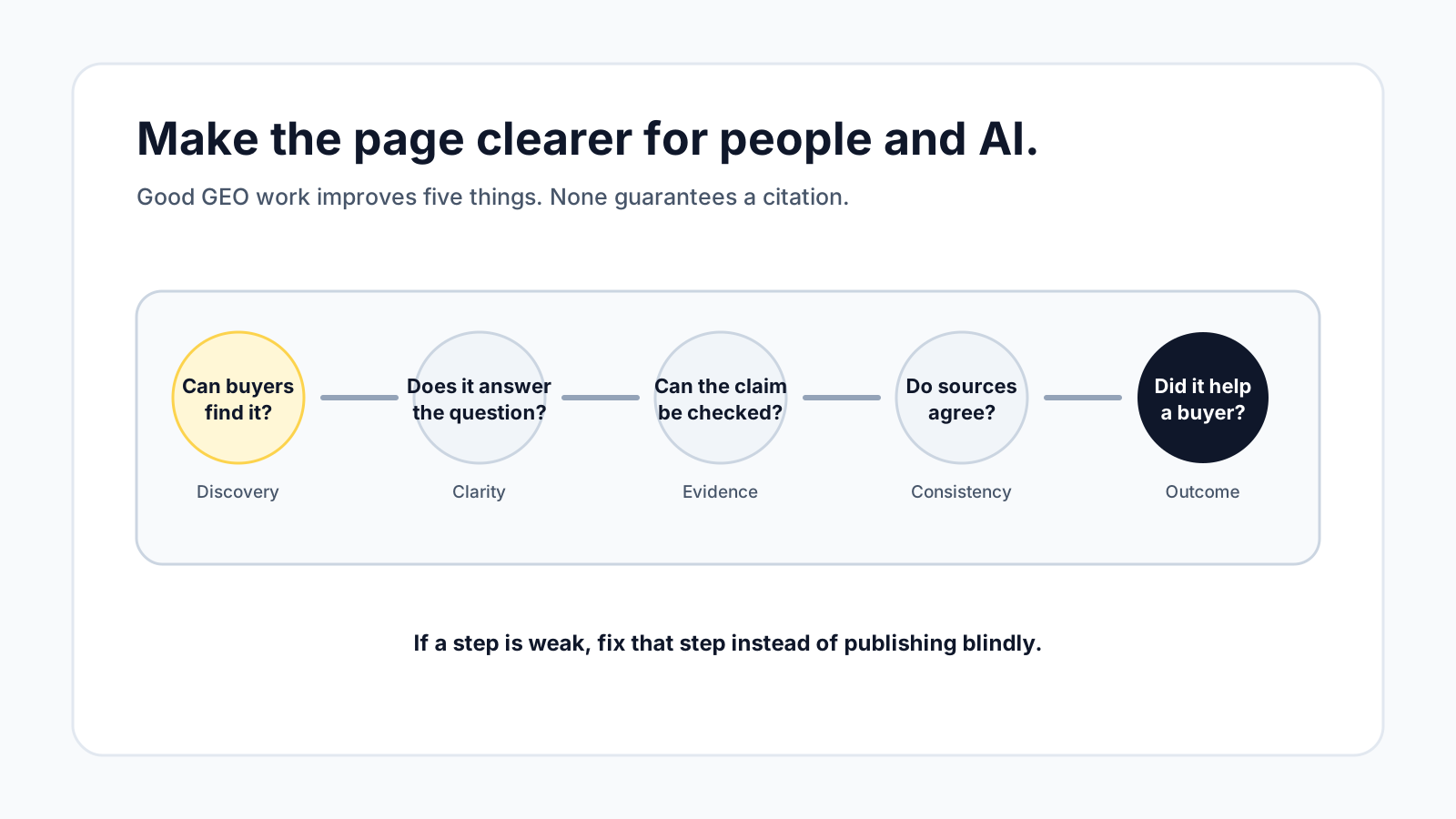
GEO is the work of closing that gap. The page should state which worker types, countries, and integrations it supports; link material claims to evidence; and explain important limits. The goal is not to impress an algorithm. It is to become a trustworthy source for a real buyer question.
What Does Generative Engine Optimization Mean?
Generative engine optimization is the practice of improving content so generative search and AI answer systems can use it accurately in their responses.
The term was introduced in the original GEO research paper, which studied how changes to source content affected visibility in generated answers. The researchers found that results varied by topic and method. That matters: GEO is an evidence-led practice, not a universal checklist that guarantees placement.
In practical B2B work, GEO has four parts:
- Make the right page accessible.
- Answer a commercially relevant question clearly.
- Support important claims with defensible evidence.
- Check whether the brand, page, and description appear across repeated AI answers.
What GEO Changes on a Page
GEO work usually changes what the page says and how confidently someone can use it.
It replaces category language with decision facts
Vague
Our platform gives growing teams a seamless way to manage global work.
Decision-ready: fictional example
Northstar supports employees and contractors in 18 countries. It integrates with QuickBooks Online and NetSuite. Employer-of-record coverage is available in 12 of those countries.
The second version gives a buyer facts to verify and compare. The exact facts must come from the product, not from a copywriter's imagination.
It answers before it expands
A page can still provide context, examples, and nuance. But the first useful paragraph should answer the heading instead of making the reader wait through a market overview.
It keeps proof close to the claim
If a page claims a certification, integration, customer result, or product limit, it should link to the relevant documentation, trust page, approved case study, or primary source. If the statement is company analysis, label it that way.
It makes important sections understandable on their own
Name the product, audience, or process instead of opening with "this solution" or "as mentioned above." A buyer who lands in the middle of the page should still understand the subject.
GEO Is Not a Secret Ranking Formula
No public document describes a complete ranking formula for ChatGPT, Google AI features, Perplexity, Claude, or other answer systems.
OpenAI's ChatGPT search guidance says ranking uses multiple factors designed to surface reliable and relevant information and that top placement cannot be guaranteed. Its publisher FAQ says allowing OAI-SearchBot helps content become eligible for summaries and snippets.
Making a page eligible does not mean it will be selected, just as a crawler request does not prove a citation and a citation does not prove a visit or sale.
Anyone promising a fixed GEO formula or guaranteed first position is claiming more certainty than the public evidence supports.
GEO Is Not a Replacement for SEO
GEO depends on many of the same fundamentals as search engine optimization:
- accessible pages;
- stable URLs;
- descriptive titles and headings;
- useful internal links;
- visible text;
- content created for a real audience.
Google's SEO Starter Guide and people-first content guidance both emphasize useful, reliable content designed to help readers rather than manipulate rankings.
SEO and GEO solve different parts of the distribution problem. SEO helps the page get discovered. GEO focuses on whether the retrieved page contains a clear, supportable answer.
For the full decision guide, read GEO vs SEO.
What Makes a Page Useful in an AI Answer?
A useful source page usually gives the answer system less room to guess.
Use this five-part check:
| Check | Question |
|---|---|
| Clear subject | Does the page plainly name the company, product, audience, and topic? |
| Direct answer | Does the first useful paragraph answer the heading? |
| Decision detail | Does the page include the facts, constraints, and trade-offs a buyer compares? |
| Evidence | Can a reader verify material claims nearby? |
| Consistency | Do important owned pages and credible outside sources describe the offer accurately? |
These qualities help humans too. A buyer should not need to decode positioning language before deciding whether the product fits.
Where GEO Work Happens
GEO is not limited to blog articles.
For B2B companies, the highest-value work often happens on:
- service and product pages;
- use-case pages;
- comparison pages;
- integration and implementation guides;
- pricing or packaging explanations;
- technical documentation;
- credible third-party profiles and reviews.
A generic article may attract visits without helping the questions that influence a sale. Start with the pages and outside sources buyers use to compare options and reduce risk.
How Do You Know GEO Is Working?
Do not collapse every signal into one visibility score.
Track the chain separately:
| Signal | What it tells you |
|---|---|
| Access | A relevant crawler can request the page |
| Citation | The page appears as a source in an answer |
| Description | The company is represented accurately |
| AI referral | A person arrives through an identifiable AI source |
| Qualified action | The visit contributes to a useful business outcome |
Repeat important buyer questions and preserve the platform, wording, date, cited URL, and search setting. One favorable screenshot is not a market position.
The separate guide to measuring LLM visibility explains how to build this into a page-level scorecard.
What Should a B2B Team Do First?
Start with one question that could affect a sale.
- Ask the question across the AI surfaces your buyers use.
- Record which brands and sources appear.
- Check whether your product genuinely fits the request.
- Inspect the page that should answer it.
- Fix the clearest access, answer, evidence, or positioning gap.
- Publish the change and repeat the same observations.
Do not create a new article by default. The best fix may be a clearer service page, corrected product documentation, a stronger comparison, or accurate information on a source outside your site.
For a detailed editing process, use how to optimize content for AI search.
Frequently Asked Questions
What is GEO in one sentence?
GEO is the work of making useful web content easier for AI answer systems to find, understand, and cite accurately.
Is GEO the same as AI SEO or answer engine optimization?
The terms overlap and are often used for similar work. The label matters less than the method: start with buyer questions, improve the relevant sources, and measure access, citations, descriptions, referrals, and outcomes separately.
Can GEO guarantee that ChatGPT recommends my company?
You can improve access, clarity, evidence, and consistency, but you cannot buy or guarantee a particular organic answer.
Does every page need GEO work?
No. Prioritize pages that answer buying questions, explain fit, compare options, or reduce implementation and purchase risk.
Does adding schema guarantee citations?
No. Structured data can provide explicit information about a page and its entities. It does not guarantee that an AI system will retrieve, cite, or recommend the page.
Do I need original research?
Not for every page. Product facts, documented methods, honest limitations, customer evidence, and primary sources can all make a page more useful. Do not add unrelated statistics merely to increase "factual density."
See Where Buyers Are Getting a Different Answer
Inflect helps B2B teams find the buyer questions worth winning, improve the pages AI systems should trust, publish with approval, and report whether visibility, qualified traffic, leads, and pipeline evidence moved. Start with the free AI visibility audit.